


Decision Making in C: if, if-else, Nested, Ladder
Decision Making in C: if, if-else, Nested if, if-else-if
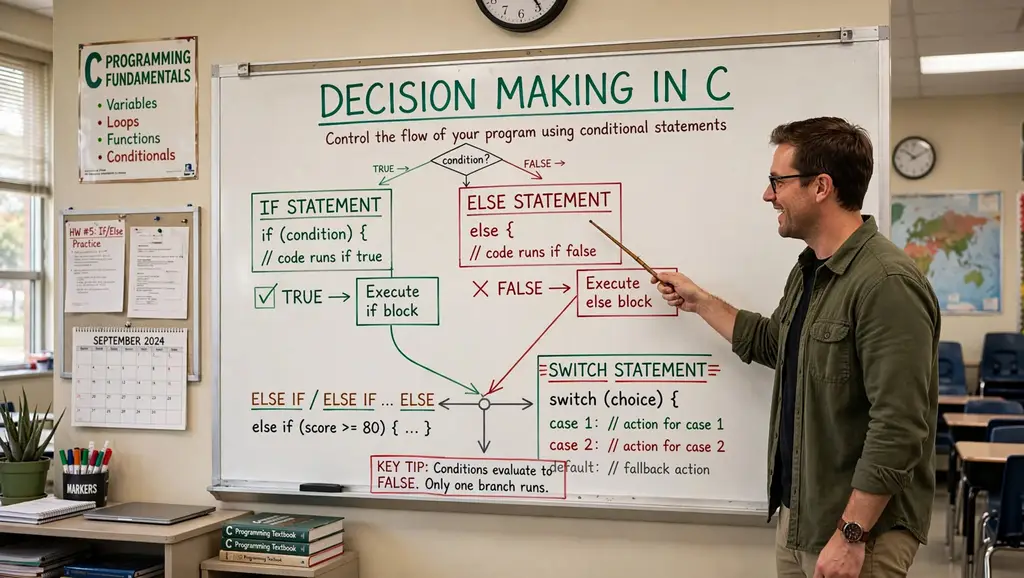
Conditional statements are fundamental control flow structures in C that allow programs to make decisions based on specific conditions. They enable the execution of different code blocks depending on whether a condition evaluates to true or false. Mastering decision-making constructs is essential for writing dynamic, responsive, and intelligent programs.
This tutorial provides an in-depth exploration of decision-making in C: if, if-else, nested if-else, if-else-if ladder, switch, and the conditional operator. It covers syntax, practical examples, common pitfalls, and best practices.
Conceptual Introduction & Fundamentals
What is Decision Making?
Decision making in programming refers to the ability of a program to choose between different execution paths based on conditions. In C, this is achieved through conditional statements that evaluate expressions and execute specific blocks of code accordingly.
Key concepts:
- Condition: An expression that evaluates to true (non-zero) or false (zero).
- Branching: Diverting program flow based on condition results.
- Blocks: Groups of statements enclosed in
{ }that execute together.
Why Decision Making Matters
- Program control: Directs execution flow based on user input, data values, or system state.
- Flexibility: Programs can respond differently to different situations.
- Error handling: Check for invalid conditions before proceeding.
- Logic implementation: Implement complex algorithms and business rules.
Types of Decision-Making Statements
C provides several decision-making constructs:
| Statement | Purpose |
|---|---|
if | Execute block if condition is true |
if-else | Execute one block if true, another if false |
Nested if-else | Multiple levels of conditions inside conditions |
if-else-if ladder | Test multiple conditions sequentially |
switch | Select from multiple cases based on value |
Conditional operator ?: | Shorthand for simple if-else |
Boolean Representation in C
C does not have a built-in bool type in C89/C90. Conditions are evaluated as integers:
- 0 = false
- Non-zero (usually 1) = true
C99 introduced _Bool type (via <stdbool.h> as bool with true/false).
Syntax & Core Mechanics
1. if Statement
The simplest decision-making statement. Executes a block only when the condition is true.
Syntax:
c
if (condition) { // statements } Example:
c
#include <stdio.h> int main(void) { int age = 20; if (age >= 18) { printf("Eligible for vote\n"); } /* Single statement without braces */ if (age > 0) printf("Age is positive\n"); return 0; } Expected output:
text
Eligible for vote Age is positive
Important: If there’s only one statement in the body, braces can be omitted. However, using braces consistently is recommended to avoid bugs.
2. if-else Statement
Executes one block if condition is true, another if false.
Syntax:
c
if (condition) { // executed if condition is true } else { // executed if condition is false } Example:
c
#include <stdio.h> int main(void) { int age = 10; if (age >= 18) { printf("Eligible for vote\n"); } else { printf("Not Eligible for vote\n"); } return 0; } Expected output:
text
Not Eligible for vote
3. Nested if-else Statement
An if or if-else statement inside another if or else block.
Syntax:
c
if (condition1) { if (condition2) { // executed if both condition1 and condition2 are true } else { // executed if condition1 true, condition2 false } } else { // executed if condition1 is false } Example:
c
#include <stdio.h> int main(void) { int age = 11; if (age >= 18) { if (age >= 60) { printf("Eligible to vote (Senior Citizen)\n"); } else { printf("Eligible for vote\n"); } } else { printf("Not eligible to vote (Under 18)\n"); if (age >= 13) { printf("Teenager\n"); } else { printf("Not a teenager\n"); } } return 0; } Expected output:
text
Not eligible to vote (Under 18) Not a teenager
4. if-else-if Ladder
Tests multiple conditions sequentially. The first true condition’s block executes.
Syntax:
c
if (condition1) { // executed if condition1 is true } else if (condition2) { // executed if condition1 false, condition2 true } else if (condition3) { // executed if condition1 and condition2 false, condition3 true } else { // executed if all conditions are false } Example:
c
#include <stdio.h> int main(void) { int score = 85; if (score >= 90) { printf("Grade: A\n"); } else if (score >= 80) { printf("Grade: B\n"); } else if (score >= 70) { printf("Grade: C\n"); } else if (score >= 60) { printf("Grade: D\n"); } else { printf("Grade: F\n"); } return 0; } Expected output:
text
Grade: B
5. switch Statement
Selects from multiple cases based on an integer or character expression.
Syntax:
c
switch (expression) { case value1: // statements break; case value2: // statements break; default: // statements break; } Example:
c
#include <stdio.h> int main(void) { int day = 3; switch (day) { case 1: printf("Monday\n"); break; case 2: printf("Tuesday\n"); break; case 3: printf("Wednesday\n"); break; case 4: printf("Thursday\n"); break; case 5: printf("Friday\n"); break; default: printf("Weekend\n"); break; } return 0; } Expected output:
text
Wednesday
Important: The break statement is crucial; without it, execution “falls through” to subsequent cases.
6. Conditional Operator (?:)
A ternary operator for simple if-else assignments.
Syntax:
c
condition ? expression1 : expression2;
If condition is true, expression1 evaluates; otherwise, expression2 evaluates.
Example:
c
#include <stdio.h> int main(void) { int flag = 0; int var; var = (flag == 0) ? 25 : -25; printf("Value of var when flag is 0: %d\n", var); int max = (10 > 5) ? 10 : 5; printf("Max: %d\n", max); return 0; } Expected output:
text
Value of var when flag is 0: 25 Max: 10
Full Practical Code Example with Explanation
This program demonstrates all decision-making constructs in a realistic scenario: a grade classification system with input validation.
Program: Student Grade Classifier
c
/** * grade_classifier.c * Demonstrates if, if-else, nested if-else, if-else-if ladder, * switch, and conditional operator. * Classifies student grades based on percentage score. */ #include <stdio.h> #include <stdlib.h> #include <string.h> #include <errno.h> #include <stdbool.h> #define MAX_LINE_LEN 100 /* Function prototypes */ int readInteger(const char *prompt, int *outValue); char getLetterGrade(int score); void printGradeComment(char grade); bool isValidScore(int score); int main(void) { int score; char letterGrade; bool passed; printf("=== Student Grade Classifier ===\n"); /* Read score with validation */ if (readInteger("Enter score (0-100): ", &score) != 0) { fprintf(stderr, "Failed to read score.\n"); return EXIT_FAILURE; } /* Validate score range using if */ if (!isValidScore(score)) { fprintf(stderr, "Invalid score. Must be between 0 and 100.\n"); return EXIT_FAILURE; } /* Determine letter grade using if-else-if ladder */ letterGrade = getLetterGrade(score); /* Check pass/fail using conditional operator */ passed = (score >= 60) ? true : false; /* Display results */ printf("\n--- Results ---\n"); printf("Score: %d\n", score); printf("Letter Grade: %c\n", letterGrade); /* Use nested if-else for additional comments */ if (passed) { printf("Status: PASSED\n"); if (score >= 90) { printf("Excellent work!\n"); } else if (score >= 80) { printf("Great job!\n"); } else if (score >= 70) { printf("Good effort!\n"); } else { printf("You passed. Keep improving!\n"); } } else { printf("Status: FAILED\n"); if (score >= 50) { printf("Close! You almost passed.\n"); } else if (score >= 40) { printf("Need significant improvement.\n"); } else { printf("Please seek help from the instructor.\n"); } } /* Use switch for letter grade comment */ printGradeComment(letterGrade); /* Demonstrate conditional operator for simple assignment */ int bonusPoints = (score >= 90) ? 5 : (score >= 80) ? 3 : (score >= 70) ? 1 : 0; printf("Bonus points earned: %d\n", bonusPoints); /* Use if-else-if for final message */ if (score == 100) { printf("Perfect score!\n"); } else if (score >= 90) { printf("Outstanding performance!\n"); } else if (score >= 80) { printf("Very good performance!\n"); } else if (score >= 70) { printf("Good performance!\n"); } else if (score >= 60) { printf("Satisfactory performance!\n"); } else { printf("Needs improvement!\n"); } return EXIT_SUCCESS; } /* Returns letter grade based on score using if-else-if ladder */ char getLetterGrade(int score) { if (score >= 90) { return 'A'; } else if (score >= 80) { return 'B'; } else if (score >= 70) { return 'C'; } else if (score >= 60) { return 'D'; } else { return 'F'; } } /* Prints a comment based on letter grade using switch */ void printGradeComment(char grade) { printf("Comment: "); switch (grade) { case 'A': printf("Outstanding!\n"); break; case 'B': printf("Very Good!\n"); break; case 'C': printf("Good!\n"); break; case 'D': printf("Satisfactory!\n"); break; case 'F': printf("Fail!\n"); break; default: printf("Invalid grade!\n"); break; } } /* Checks if score is in valid range */ bool isValidScore(int score) { return (score >= 0 && score <= 100); } /* Reads an integer safely */ int readInteger(const char *prompt, int *outValue) { char buffer[MAX_LINE_LEN]; char *endPtr; long val; while (1) { printf("%s", prompt); fflush(stdout); if (fgets(buffer, sizeof(buffer), stdin) == NULL) { return -1; } errno = 0; val = strtol(buffer, &endPtr, 10); if (endPtr == buffer || (*endPtr != '\n' && *endPtr != '\0')) { printf("Invalid integer. Please try again.\n"); continue; } if (errno == ERANGE || val < -2147483647 - 1 || val > 2147483647) { printf("Number out of range. Please try again.\n"); continue; } *outValue = (int)val; return 0; } } Explanation of Decision-Making Usage
ifstatement: Validates score range:if (!isValidScore(score)).if-else-ifladder: IngetLetterGrade(), determines letter grade based on score ranges.- Nested
if-else: Inmain(), provides detailed comments based on pass/fail status and score ranges. switch: InprintGradeComment(), selects comment based on letter grade.- Conditional operator: Assigns
passedstatus andbonusPoints. if-else-iffor final message: Provides multiple conditions for performance feedback.
Expected Output
Sample run 1 (score = 95):
text
=== Student Grade Classifier === Enter score (0-100): 95 --- Results --- Score: 95 Letter Grade: A Status: PASSED Excellent work! Comment: Outstanding! Bonus points earned: 5 Outstanding performance!
Sample run 2 (score = 45):
text
=== Student Grade Classifier === Enter score (0-100): 45 --- Results --- Score: 45 Letter Grade: F Status: FAILED Please seek help from the instructor. Comment: Fail! Bonus points earned: 0 Needs improvement!
Sample run 3 (invalid score):
text
=== Student Grade Classifier === Enter score (0-100): 150 Invalid score. Must be between 0 and 100.
Common Pitfalls, Edge Cases & Memory Considerations
1. Using = Instead of ==
Assignment (=) in a condition always evaluates to true (non-zero) unless the assigned value is 0.
c
if (a = 10) { // Always true; assigns 10 to a } Solution: Use == for comparison. Enable compiler warnings (-Wall).
2. Dangling else
An else always binds to the nearest unmatched if, not the one you might intend.
c
if (condition1) if (condition2) printf("Both true\n"); else printf("condition1 false or condition2 false?\n"); // This else binds to inner if Solution: Use braces to clarify binding:
c
if (condition1) { if (condition2) printf("Both true\n"); } else { printf("condition1 false\n"); } 3. Forgetting Braces for Multiple Statements
Without braces, only the first statement after if is part of the block.
c
if (condition) statement1; statement2; // This always executes, not part of if
Solution: Always use braces, even for single statements:
c
if (condition) { statement1; statement2; } 4. switch Fall-Through
Forgetting break causes execution to continue into the next case.
c
switch (x) { case 1: printf("One\n"); case 2: printf("Two\n"); // Executes for x == 1 and x == 2 } Solution: Always use break unless fall-through is intentional. Document intentional fall-through with a comment.
5. switch Expression Type
switch expression must be integer or character type. Floating-point or strings are not allowed.
c
switch (3.14) { // Error: switch quantity not an integer } Solution: Use if-else-if for non-integer conditions.
6. Comparison Chaining
a < b < c does not work as expected in C.
c
if (a < b < c) { // Evaluates as (a < b) < c } Solution: Use logical operators: if (a < b && b < c).
7. Floating-Point Equality
Comparing floating-point values for equality is unreliable due to precision.
c
float f = 0.1f + 0.2f; if (f == 0.3f) { // May be false } Solution: Use epsilon comparison: fabs(f - 0.3f) < 0.0001f.
8. Side Effects in Conditions
Conditions with side effects can be confusing and error-prone.
c
if (i++ > 5 && array[i] > 0) { // i is incremented before array access } Solution: Avoid side effects in conditions; perform them separately.
9. Uninitialized Variables in Conditions
Using uninitialized variables in conditions is undefined behavior.
c
int x; if (x > 10) { // x is garbage } Solution: Always initialize variables before use.
10. Memory Considerations
- Decision-making constructs do not allocate dynamic memory.
- Nested conditions can increase stack usage if large local variables are declared in blocks.
- Avoid deeply nested
if-else(more than 3-4 levels) as it hurts readability; considerswitchor functions instead.
Summary & Best Practices
Decision-making statements in C allow programs to execute different code paths based on conditions. Understanding the various constructs and their proper use is essential for writing clear, correct, and maintainable code.
Key Takeaways
ifexecutes a block when a condition is true.if-elseprovides an alternative block when the condition is false.- Nested
if-elsechecks conditions inside other conditions. if-else-ifladder tests multiple conditions sequentially.switchselects from multiple cases based on an integer/character value.- Conditional operator
?:is a shorthand for simple if-else. - Always use braces to avoid dangling
elseand block errors.
Best Practices
- Use braces
{ }consistently for all control flow blocks, even single statements. - Use
==for comparison and=for assignment; enable compiler warnings. - Avoid side effects in conditions; keep conditions simple and pure.
- Use
if-else-ifladder when testing multiple ranges or discrete values. - Use
switchwhen comparing against many constant values. - Use conditional operator only for simple, clear assignments.
- Limit nesting depth (3-4 levels max); refactor into functions if deeper.
- Validate inputs before using them in conditions.
- Use
booltype (from<stdbool.h>) for boolean variables and return types. - Document complex conditions with comments explaining the logic.
By mastering decision-making in C, you’ll write programs that respond intelligently to different situations, handle errors gracefully, and implement complex logic clearly.