CoreTechED

Loading

Learn to remove minimum elements so two arrays have no common elements in C: two-map and single-map O(n+m) approaches with code examples.

Remove Minimum Elements so No Common Elements in C

Remove Minimum Elements so No Common Elements Exist in Two Arrays (C Tutorial)

Given two arrays, find the minimum number of elements that must be removed (across both arrays combined) so that the resulting arrays have no common elements. This problem is a subtle twist on intersection counting — and the solution is remarkably elegant.

This tutorial covers the insight, two C implementations (two maps vs. single map), edge cases, and best practices.


Conceptual Introduction & Fundamentals

What is the Problem?

Given two arrays arr1[] (size n) and arr2[] (size m), find the minimum number of elements to remove (from either array) so that no value appears in both arrays.

Examples:

text

Input: arr1 = [2, 3, 4, 5, 8], arr2 = [1, 2, 3, 4] Output: 3 (remove 2, 3, 4 from one array) Input: arr1 = [1, 2, 3, 4], arr2 = [5, 6, 7] Output: 0 (no common elements)

Why This Problem Matters

  • Set operations: Deepens understanding of intersection.
  • Multiset reasoning: Frequencies matter, not just presence.
  • Two implementation strategies: Two maps vs. one map.
  • Real-world use: Data deduplication, cache invalidation, conflict resolution.
  • Interview preparation: Common coding interview question.

Key Insight

For each value v present in both arrays with frequencies f1(v) in arr1 and f2(v) in arr2, we must remove all copies from one side (or split removals) so no copy remains in both arrays. The cheapest approach is to remove min(f1(v), f2(v)) copies — remove all copies from the side with fewer.

Summing over all common values:

text

answer = Σ over common values v of min(f1(v), f2(v))

Approaches Overview

ApproachTimeSpace
Two hash mapsO(n + m)O(n + m)
Single hash mapO(n + m)O(n)

Syntax & Core Mechanics

Approach 1: Two Hash Maps

Count frequencies in both arrays; sum min(f1, f2) for common values.

c

#include <stdio.h> #include <stdlib.h> #define TABLE_SIZE 4096 typedef struct { int *keys; int *counts; int *occupied; int capacity; } FreqMap; static unsigned int hashFunc(int key, int cap) { return ((unsigned int)key) % (unsigned int)cap; } FreqMap *createMap(int cap) { FreqMap *m = malloc(sizeof(FreqMap)); if (m == NULL) return NULL; m->keys = malloc((size_t)cap * sizeof(int)); m->counts = calloc((size_t)cap, sizeof(int)); m->occupied = calloc((size_t)cap, sizeof(int)); if (m->keys == NULL || m->counts == NULL || m->occupied == NULL) { free(m->keys); free(m->counts); free(m->occupied); free(m); return NULL; } m->capacity = cap; return m; } void freeMap(FreqMap *m) { if (m) { free(m->keys); free(m->counts); free(m->occupied); free(m); } } void increment(FreqMap *m, int key) { unsigned int idx = hashFunc(key, m->capacity); int start = (int)idx; while (m->occupied[idx]) { if (m->keys[idx] == key) { m->counts[idx]++; return; } idx = (idx + 1) % (unsigned int)m->capacity; if ((int)idx == start) return; } m->keys[idx] = key; m->counts[idx] = 1; m->occupied[idx] = 1; } int getCount(FreqMap *m, int key) { unsigned int idx = hashFunc(key, m->capacity); int start = (int)idx; while (m->occupied[idx]) { if (m->keys[idx] == key) return m->counts[idx]; idx = (idx + 1) % (unsigned int)m->capacity; if ((int)idx == start) break; } return 0; } long long minRemoveTwoMaps(const int a[], int n, const int b[], int m) { FreqMap *ma = createMap(TABLE_SIZE); FreqMap *mb = createMap(TABLE_SIZE); if (ma == NULL || mb == NULL) { freeMap(ma); freeMap(mb); return -1; } for (int i = 0; i < n; i++) increment(ma, a[i]); for (int i = 0; i < m; i++) increment(mb, b[i]); long long res = 0; for (int i = 0; i < ma->capacity; i++) { if (!ma->occupied[i]) continue; int v = ma->keys[i]; int c2 = getCount(mb, v); if (c2 > 0) { int c1 = ma->counts[i]; res += (c1 < c2) ? c1 : c2; } } freeMap(ma); freeMap(mb); return res; } int main(void) { int arr1[] = {2, 3, 4, 5, 8}; int arr2[] = {1, 2, 3, 4}; printf("%lld\n", minRemoveTwoMaps(arr1, 5, arr2, 4)); return 0; }

Expected output:

text

3

Time: O(n + m), Space: O(n + m)

Approach 2: Single Hash Map (Optimal)

Count arr1 frequencies in one map; iterate arr2; when a value with positive count is found, decrement and add 1.

c

long long minRemoveSingleMap(const int a[], int n, const int b[], int m) { FreqMap *count = createMap(TABLE_SIZE); if (count == NULL) return -1; for (int i = 0; i < n; i++) increment(count, a[i]); long long res = 0; for (int i = 0; i < m; i++) { int c = getCount(count, b[i]); if (c > 0) { /* Decrement manually */ unsigned int idx = hashFunc(b[i], count->capacity); int start = (int)idx; while (count->occupied[idx]) { if (count->keys[idx] == b[i]) { count->counts[idx]--; break; } idx = (idx + 1) % (unsigned int)count->capacity; if ((int)idx == start) break; } res++; } } freeMap(count); return res; }

Time: O(n + m), Space: O(n)

Step-by-Step Trace for arr1 = [1,2,3,4], arr2 = [2,3,4,5,8]

text

Insert into count: {1:1, 2:1, 3:1, 4:1} Iterate arr2: 2 → count[2] = 1 > 0 → decrement to 0, res = 1 3 → count[3] = 1 > 0 → decrement to 0, res = 2 4 → count[4] = 1 > 0 → decrement to 0, res = 3 5 → count[5] = 0 → skip 8 → count[8] = 0 → skip Return 3 ✓

Full Practical Code Example with Explanation

This program implements both approaches, cross-verifies them, and exercises edge cases.

c

/** * min_remove_no_common.c * Minimum elements to remove so no common elements exist. * Compares two-map and single-map approaches. */ #include <stdio.h> #include <stdlib.h> #include <string.h> #include <errno.h> #include <time.h> #define MAX_LINE_LEN 100 #define TABLE_SIZE 262144 /* ============================================================ * FreqMap * ============================================================ */ typedef struct { int *keys; int *counts; int *occupied; int capacity; } FreqMap; static unsigned int hashFunc(int key, int cap) { return ((unsigned int)key) % (unsigned int)cap; } FreqMap *createMap(int cap) { FreqMap *m = malloc(sizeof(FreqMap)); if (m == NULL) return NULL; m->keys = malloc((size_t)cap * sizeof(int)); m->counts = calloc((size_t)cap, sizeof(int)); m->occupied = calloc((size_t)cap, sizeof(int)); if (m->keys == NULL || m->counts == NULL || m->occupied == NULL) { free(m->keys); free(m->counts); free(m->occupied); free(m); return NULL; } m->capacity = cap; return m; } void freeMap(FreqMap *m) { if (m) { free(m->keys); free(m->counts); free(m->occupied); free(m); } } void increment(FreqMap *m, int key) { unsigned int idx = hashFunc(key, m->capacity); int start = (int)idx; while (m->occupied[idx]) { if (m->keys[idx] == key) { m->counts[idx]++; return; } idx = (idx + 1) % (unsigned int)m->capacity; if ((int)idx == start) return; } m->keys[idx] = key; m->counts[idx] = 1; m->occupied[idx] = 1; } int getCount(FreqMap *m, int key) { unsigned int idx = hashFunc(key, m->capacity); int start = (int)idx; while (m->occupied[idx]) { if (m->keys[idx] == key) return m->counts[idx]; idx = (idx + 1) % (unsigned int)m->capacity; if ((int)idx == start) break; } return 0; } void decrement(FreqMap *m, int key) { unsigned int idx = hashFunc(key, m->capacity); int start = (int)idx; while (m->occupied[idx]) { if (m->keys[idx] == key) { m->counts[idx]--; return; } idx = (idx + 1) % (unsigned int)m->capacity; if ((int)idx == start) return; } } /* ============================================================ * Approaches * ============================================================ */ long long minRemoveTwoMaps(const int a[], int n, const int b[], int m) { FreqMap *ma = createMap(TABLE_SIZE); FreqMap *mb = createMap(TABLE_SIZE); if (ma == NULL || mb == NULL) { freeMap(ma); freeMap(mb); return -1; } for (int i = 0; i < n; i++) increment(ma, a[i]); for (int i = 0; i < m; i++) increment(mb, b[i]); long long res = 0; for (int i = 0; i < ma->capacity; i++) { if (!ma->occupied[i]) continue; int v = ma->keys[i]; int c2 = getCount(mb, v); if (c2 > 0) { int c1 = ma->counts[i]; res += (c1 < c2) ? c1 : c2; } } freeMap(ma); freeMap(mb); return res; } long long minRemoveSingleMap(const int a[], int n, const int b[], int m) { FreqMap *count = createMap(TABLE_SIZE); if (count == NULL) return -1; for (int i = 0; i < n; i++) increment(count, a[i]); long long res = 0; for (int i = 0; i < m; i++) { if (getCount(count, b[i]) > 0) { decrement(count, b[i]); res++; } } freeMap(count); return res; } /* ============================================================ * Utility * ============================================================ */ void printArray(const int arr[], int n) { printf("["); for (int i = 0; i < n; i++) { printf("%d", arr[i]); if (i < n - 1) printf(", "); } printf("]"); } static void demoBasic(void) { printf("\n=== Sample Arrays ===\n"); int a1[] = {2, 3, 4, 5, 8}; int b1[] = {1, 2, 3, 4}; int a2[] = {1, 2, 3, 4}; int b2[] = {5, 6, 7}; int a3[] = {1, 2, 2, 3}; int b3[] = {2, 2, 2, 4}; struct { int *a; int n; int *b; int m; const char *label; } tests[] = { {a1, 5, b1, 4, "arr1=[2,3,4,5,8], arr2=[1,2,3,4]"}, {a2, 4, b2, 3, "arr1=[1,2,3,4], arr2=[5,6,7]"}, {a3, 4, b3, 4, "arr1=[1,2,2,3], arr2=[2,2,2,4]"} }; int nt = sizeof(tests) / sizeof(tests[0]); for (int t = 0; t < nt; t++) { printf("\nTest %d: %s\n", t + 1, tests[t].label); printf(" arr1: "); printArray(tests[t].a, tests[t].n); printf("\n"); printf(" arr2: "); printArray(tests[t].b, tests[t].m); printf("\n"); long long r1 = minRemoveTwoMaps(tests[t].a, tests[t].n, tests[t].b, tests[t].m); long long r2 = minRemoveSingleMap(tests[t].a, tests[t].n, tests[t].b, tests[t].m); printf(" Two-map: %lld\n Single-map: %lld\n", r1, r2); printf(" Verify: %s\n", (r1 == r2) ? "PASS" : "FAIL"); } printf("\n"); } static void demoEdgeCases(void) { printf("\n=== Edge Cases ===\n"); /* Empty arrays */ printf("Both empty: %lld / %lld\n", minRemoveTwoMaps(NULL, 0, NULL, 0), minRemoveSingleMap(NULL, 0, NULL, 0)); /* One empty */ int a1[] = {1, 2, 3}; printf("arr2 empty: %lld / %lld\n", minRemoveTwoMaps(a1, 3, NULL, 0), minRemoveSingleMap(a1, 3, NULL, 0)); /* Disjoint */ int a2[] = {1, 2}; int b2[] = {3, 4}; printf("Disjoint: %lld / %lld (expect 0)\n", minRemoveTwoMaps(a2, 2, b2, 2), minRemoveSingleMap(a2, 2, b2, 2)); /* Identical */ int a3[] = {5, 5, 5}; int b3[] = {5, 5, 5}; printf("Identical [5,5,5]: %lld / %lld (expect 3)\n", minRemoveTwoMaps(a3, 3, b3, 3), minRemoveSingleMap(a3, 3, b3, 3)); /* Different frequencies */ int a4[] = {1, 1, 1, 2}; int b4[] = {1, 2, 2, 2}; printf("Different freqs: %lld / %lld (expect min(3,1)+min(1,3)=2)\n", minRemoveTwoMaps(a4, 4, b4, 4), minRemoveSingleMap(a4, 4, b4, 4)); /* Single common element */ int a5[] = {7, 8, 9}; int b5[] = {10, 7, 11}; printf("Single common: %lld / %lld (expect 1)\n", minRemoveTwoMaps(a5, 3, b5, 3), minRemoveSingleMap(a5, 3, b5, 3)); /* Negatives */ int a6[] = {-1, -2, -3}; int b6[] = {-2, -3, -4}; printf("Negatives: %lld / %lld (expect 2)\n", minRemoveTwoMaps(a6, 3, b6, 3), minRemoveSingleMap(a6, 3, b6, 3)); /* Zero */ int a7[] = {0, 0, 1}; int b7[] = {0, 2}; printf("Zero: %lld / %lld (expect min(2,1)=1)\n", minRemoveTwoMaps(a7, 3, b7, 2), minRemoveSingleMap(a7, 3, b7, 2)); } static void performanceTest(void) { printf("\n=== Performance Comparison ===\n"); int n = 5000000, m = 5000000; int *a = malloc((size_t)n * sizeof(int)); int *b = malloc((size_t)m * sizeof(int)); if (a == NULL || b == NULL) { free(a); free(b); return; } srand(42); for (int i = 0; i < n; i++) a[i] = rand() % 200000; for (int i = 0; i < m; i++) b[i] = rand() % 200000; clock_t start, end; double t; start = clock(); long long r1 = minRemoveTwoMaps(a, n, b, m); end = clock(); t = ((double)(end - start)) / CLOCKS_PER_SEC * 1000.0; printf("Two-map (n=%d, m=%d): result=%lld, time=%.3f ms\n", n, m, r1, t); start = clock(); long long r2 = minRemoveSingleMap(a, n, b, m); end = clock(); t = ((double)(end - start)) / CLOCKS_PER_SEC * 1000.0; printf("Single-map (n=%d, m=%d): result=%lld, time=%.3f ms\n", n, m, r2, t); printf("Verify: %s\n", (r1 == r2) ? "PASS" : "FAIL"); free(a); free(b); } static int readInteger(const char *prompt, int *outValue) { char buffer[MAX_LINE_LEN]; char *endPtr; long val; printf("%s", prompt); fflush(stdout); if (fgets(buffer, sizeof(buffer), stdin) == NULL) return -1; errno = 0; val = strtol(buffer, &endPtr, 10); if (endPtr == buffer || (*endPtr != '\n' && *endPtr != '\0')) return -1; if (errno == ERANGE || val < -2147483647 - 1 || val > 2147483647) return -1; *outValue = (int)val; return 0; } static void demoInteractive(void) { int n, m; if (readInteger("Enter arr1 size (0-10000): ", &n) != 0 || n < 0 || n > 10000) { printf("Invalid size.\n"); return; } int *a = NULL; if (n > 0) { a = malloc((size_t)n * sizeof(int)); if (a == NULL) return; for (int i = 0; i < n; i++) { char p[40]; snprintf(p, sizeof(p), " arr1[%d]: ", i); if (readInteger(p, &a[i]) != 0) { free(a); return; } } } if (readInteger("Enter arr2 size (0-10000): ", &m) != 0 || m < 0 || m > 10000) { printf("Invalid size.\n"); free(a); return; } int *b = NULL; if (m > 0) { b = malloc((size_t)m * sizeof(int)); if (b == NULL) { free(a); return; } for (int i = 0; i < m; i++) { char p[40]; snprintf(p, sizeof(p), " arr2[%d]: ", i); if (readInteger(p, &b[i]) != 0) { free(a); free(b); return; } } } printf("\nMinimum removals: %lld\n", minRemoveSingleMap(a, n, b, m)); free(a); free(b); } int main(void) { int choice; char buffer[MAX_LINE_LEN]; printf("=== Minimum Removals so No Common Elements Demo ===\n"); while (1) { printf("\n--- Menu ---\n"); printf("1. Demonstrate Both Approaches\n"); printf("2. Edge Cases\n"); printf("3. Performance Comparison\n"); printf("4. Interactive\n"); printf("5. Exit\n"); printf("Enter choice: "); fflush(stdout); if (fgets(buffer, sizeof(buffer), stdin) == NULL) { fprintf(stderr, "Error reading choice.\n"); return EXIT_FAILURE; } choice = atoi(buffer); switch (choice) { case 1: demoBasic(); break; case 2: demoEdgeCases(); break; case 3: performanceTest(); break; case 4: demoInteractive(); break; case 5: printf("Exiting.\n"); return EXIT_SUCCESS; default: printf("Invalid choice.\n"); break; } } return EXIT_SUCCESS; }

Explanation of the Approaches

  1. Two maps: Count frequencies of both arrays; for each shared value, add min(f1, f2).
  2. Single map: Count arr1; iterate arr2 and decrement each found value, adding 1 per match.

Both compute the same sum. The single map saves memory and cache pressure.

Expected Output (sample run)

text

=== Sample Arrays === Test 1: arr1=[2,3,4,5,8], arr2=[1,2,3,4] arr1: [2, 3, 4, 5, 8] arr2: [1, 2, 3, 4] Two-map: 3 Single-map: 3 Verify: PASS Test 2: arr1=[1,2,3,4], arr2=[5,6,7] arr1: [1, 2, 3, 4] arr2: [5, 6, 7] Two-map: 0 Single-map: 0 Verify: PASS Test 3: arr1=[1,2,2,3], arr2=[2,2,2,4] arr1: [1, 2, 2, 3] arr2: [2, 2, 2, 4] Two-map: 2 Single-map: 2 Verify: PASS === Edge Cases === Both empty: 0 / 0 arr2 empty: 0 / 0 Disjoint: 0 / 0 (expect 0) Identical [5,5,5]: 3 / 3 (expect 3) Different freqs: 2 / 2 (expect min(3,1)+min(1,3)=2) Single common: 1 / 1 (expect 1) Negatives: 2 / 2 (expect 2) Zero: 1 / 1 (expect min(2,1)=1)

Common Pitfalls, Edge Cases & Memory Considerations

1. Forgetting Frequencies

Two arrays with the same value but different counts need careful handling.

c

arr1 = [1, 1, 1] arr2 = [1] → remove 1 (min(3, 1) = 1)

2. Using Sets Instead of Maps

A set ignores frequencies and overcounts.

Solution: Use frequency maps.

3. Counting Per Value vs. Total

The answer sums min(f1, f2) across all shared values, not just one.

4. Integer Overflow in Sum

For large arrays with many duplicates, the sum can exceed int.

Solution: Use long long.

5. Empty Arrays

Any of n = 0 or m = 0 yields 0 (no removals needed).

6. Hash Table Sizing

Undersized tables cause probe failures.

Solution: Size ≥ 2× distinct values.

7. Negative Keys

Cast to unsigned int in the hash function.

8. Mutating Input

Both approaches leave inputs intact.

9. decrement Call on Missing Key

Guard with getCount() > 0 before decrementing.

10. Memory Considerations

  • Two maps: O(n + m) space.
  • Single map: O(n) space — preferred.
  • Free allocated memory.
  • Use long long for the total.

Summary & Best Practices

The minimum-removals problem reduces to summing min(f1(v), f2(v)) over all shared values. The single-map approach achieves O(n + m) time and O(n) space.

Key Takeaways

  • Answer = Σ min(f1(v), f2(v)) for v common to both arrays.
  • Two maps: O(n + m) time, O(n + m) space.
  • Single map: O(n + m) time, O(n) space — preferred.
  • Remove from the side with fewer copies per value.
  • Use long long for the total.

Best Practices

  1. Use the single-map approach for better memory usage.
  2. Track frequencies, not just membership.
  3. Sum min(f1, f2) per common value.
  4. Use long long for the answer.
  5. Guard decrements with a positive count check.
  6. Size hash tables ≥ 2× distinct values.
  7. Cast negative keys to unsigned int.
  8. Free all allocated memory.
  9. Test edge cases: empty, disjoint, identical, unequal frequencies.
  10. Profile for large inputs.

By mastering this problem, you’ll deepen your intuition for multiset operations, frequency counting, and set-theoretic reductions.

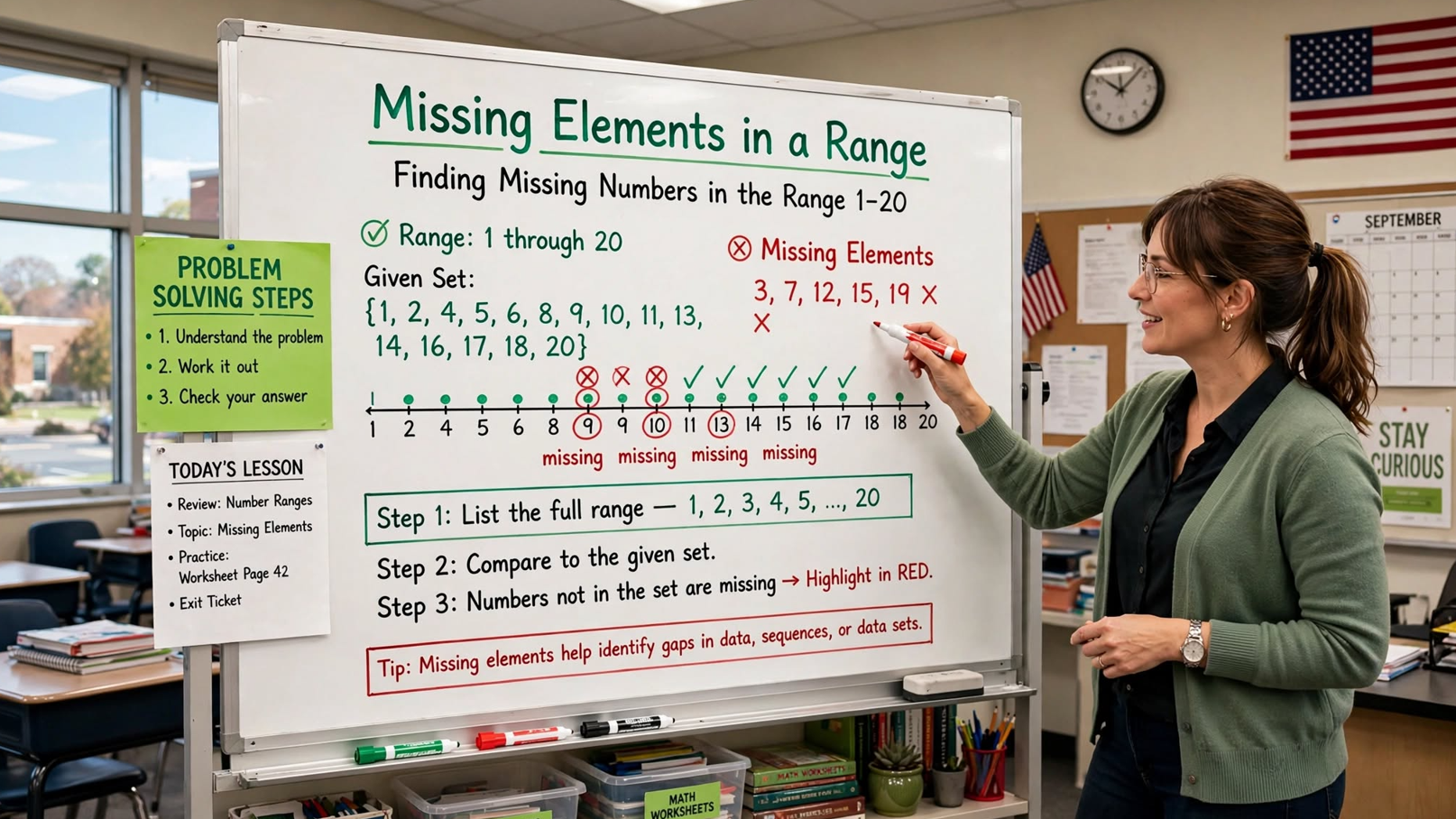
Learn to count missing elements of a range in C arrays: sort-based O(n log n) and hash set O(n) approaches with code examples and edge cases.

Missing Elements of a Range in an Array: C Guide

Missing Elements of a Range in an Array in C: A Comprehensive Tutorial

Given an array, let min and max be the smallest and largest elements. The task is to count how many integers must be added so that every value in [min, max] appears at least once. This problem is about counting gaps in a value range, not the indices of the array. It’s a compact exercise in reasoning about sets versus ranges.

This tutorial covers two approaches in C: sorting-based O(n log n) and hash-set-based O(n), each with portable C99/C11 code and complete output examples.


Conceptual Introduction & Fundamentals

What is the Problem?

Given arr[] of size n, let:

  • min = minimum element
  • max = maximum element
  • range_size = max - min + 1

Count how many integers in [min, max] are not present in the array.

Examples:

text

Input: [4, 5, 3, 8, 6] Output: 1 Explanation: Range is [3, 8]; only 7 is missing. Input: [2, 1, 3] Output: 0 Explanation: Range is [1, 3]; nothing is missing.

Why This Problem Matters

  • Set vs range: Distinguishes distinct elements from the covered range.
  • Handling duplicates: Sets collapse duplicates; arrays do not.
  • Two clean solutions: Sorting and hashing with the same asymptotic idea.
  • Real-world use: Completeness of ID ranges, sensor calibration ranges, exam number gaps.
  • Interview preparation: Common coding interview question.

Key Identity

text

missing_count = (max - min + 1) - distinct_count

Where distinct_count is the number of unique values in the array.

Approaches Overview

ApproachTimeSpace
SortingO(n log n)O(1) or O(n)
Hash setO(n) averageO(n)

Syntax & Core Mechanics

Approach 1: Sorting

Sort the array; walk adjacent pairs, adding gaps between distinct consecutive values.

c

#include <stdio.h> #include <stdlib.h> #include <string.h> static int compareInts(const void *a, const void *b) { int x = *(const int *)a; int y = *(const int *)b; return (x > y) - (x < y); } long long countMissingSorted(const int arr_in[], int n) { if (n <= 1) return 0; int *arr = malloc((size_t)n * sizeof(int)); if (arr == NULL) return -1; memcpy(arr, arr_in, (size_t)n * sizeof(int)); qsort(arr, n, sizeof(int), compareInts); long long missing = 0; for (int i = 0; i < n - 1; i++) { int cur = arr[i]; int nxt = arr[i + 1]; if (nxt > cur + 1) { missing += (long long)(nxt - cur - 1); } /* If nxt == cur (duplicate) or nxt == cur+1, add nothing. */ } free(arr); return missing; } int main(void) { int arr[] = {4, 5, 3, 8, 6}; int n = sizeof(arr) / sizeof(arr[0]); printf("%lld\n", countMissingSorted(arr, n)); return 0; }

Expected output:

text

1

Time: O(n log n), Space: O(n) for copy

Why skip duplicates? Adjacent equal values contribute 0 to the gap because nxt - cur - 1 = -1, which would be wrong. The condition nxt > cur + 1 correctly skips both duplicates and consecutive integers.

Approach 2: Hash Set

Track distinct values in a set; also track min and max.

c

#include <stdio.h> #include <stdlib.h> #include <limits.h> #define TABLE_SIZE 8192 typedef struct { int *keys; int *occupied; int capacity; int size; } HashSet; static unsigned int hashFunc(int key, int cap) { return ((unsigned int)key) % (unsigned int)cap; } HashSet *createSet(int cap) { HashSet *s = malloc(sizeof(HashSet)); if (s == NULL) return NULL; s->keys = malloc((size_t)cap * sizeof(int)); s->occupied = calloc((size_t)cap, sizeof(int)); if (s->keys == NULL || s->occupied == NULL) { free(s->keys); free(s->occupied); free(s); return NULL; } s->capacity = cap; s->size = 0; return s; } void freeSet(HashSet *s) { if (s) { free(s->keys); free(s->occupied); free(s); } } int setInsert(HashSet *s, int key) { unsigned int idx = hashFunc(key, s->capacity); int start = (int)idx; while (s->occupied[idx]) { if (s->keys[idx] == key) return 0; /* Already present */ idx = (idx + 1) % (unsigned int)s->capacity; if ((int)idx == start) return -1; /* Full */ } s->keys[idx] = key; s->occupied[idx] = 1; s->size++; return 1; } long long countMissingHash(const int arr[], int n) { if (n <= 1) return 0; HashSet *s = createSet(TABLE_SIZE); if (s == NULL) return -1; int minv = INT_MAX, maxv = INT_MIN; for (int i = 0; i < n; i++) { setInsert(s, arr[i]); if (arr[i] < minv) minv = arr[i]; if (arr[i] > maxv) maxv = arr[i]; } long long range_size = (long long)maxv - (long long)minv + 1; long long result = range_size - (long long)s->size; freeSet(s); return result; } int main(void) { int arr[] = {4, 5, 3, 8, 6}; int n = sizeof(arr) / sizeof(arr[0]); printf("%lld\n", countMissingHash(arr, n)); return 0; }

Expected output:

text

1

Time: O(n) average, Space: O(n)

Why Hash Wins for Large Inputs

The set approach handles unsorted input, duplicates, and arbitrarily wide ranges without allocating per-range memory.


Full Practical Code Example with Explanation

This program implements both approaches and verifies their agreement.

c

/** * missing_range_count.c * Counts how many integers are missing from [min, max] of an array. * Compares sorting and hash set approaches. */ #include <stdio.h> #include <stdlib.h> #include <string.h> #include <errno.h> #include <limits.h> #include <time.h> #define MAX_LINE_LEN 100 #define TABLE_SIZE 262144 /* ============================================================ * HashSet * ============================================================ */ typedef struct { int *keys; int *occupied; int capacity; int size; } HashSet; static unsigned int hashFunc(int key, int cap) { return ((unsigned int)key) % (unsigned int)cap; } HashSet *createSet(int cap) { HashSet *s = malloc(sizeof(HashSet)); if (s == NULL) return NULL; s->keys = malloc((size_t)cap * sizeof(int)); s->occupied = calloc((size_t)cap, sizeof(int)); if (s->keys == NULL || s->occupied == NULL) { free(s->keys); free(s->occupied); free(s); return NULL; } s->capacity = cap; s->size = 0; return s; } void freeSet(HashSet *s) { if (s) { free(s->keys); free(s->occupied); free(s); } } int setInsert(HashSet *s, int key) { unsigned int idx = hashFunc(key, s->capacity); int start = (int)idx; while (s->occupied[idx]) { if (s->keys[idx] == key) return 0; idx = (idx + 1) % (unsigned int)s->capacity; if ((int)idx == start) return -1; } s->keys[idx] = key; s->occupied[idx] = 1; s->size++; return 1; } /* ============================================================ * Approaches * ============================================================ */ static int compareInts(const void *a, const void *b) { int x = *(const int *)a; int y = *(const int *)b; return (x > y) - (x < y); } long long countMissingSorted(const int arr_in[], int n) { if (n <= 1) return 0; int *arr = malloc((size_t)n * sizeof(int)); if (arr == NULL) return -1; memcpy(arr, arr_in, (size_t)n * sizeof(int)); qsort(arr, n, sizeof(int), compareInts); long long missing = 0; for (int i = 0; i < n - 1; i++) { int cur = arr[i], nxt = arr[i + 1]; if (nxt > cur + 1) { missing += (long long)(nxt - cur - 1); } } free(arr); return missing; } long long countMissingHash(const int arr[], int n) { if (n <= 1) return 0; HashSet *s = createSet(TABLE_SIZE); if (s == NULL) return -1; int minv = INT_MAX, maxv = INT_MIN; for (int i = 0; i < n; i++) { setInsert(s, arr[i]); if (arr[i] < minv) minv = arr[i]; if (arr[i] > maxv) maxv = arr[i]; } long long range_size = (long long)maxv - (long long)minv + 1; long long result = range_size - (long long)s->size; freeSet(s); return result; } /* ============================================================ * Utility * ============================================================ */ void printArray(const int arr[], int n) { printf("["); for (int i = 0; i < n; i++) { printf("%d", arr[i]); if (i < n - 1) printf(", "); } printf("]"); } static void demoBasic(void) { printf("\n=== Sample Arrays ===\n"); int a1[] = {4, 5, 3, 8, 6}; int a2[] = {2, 1, 3}; int a3[] = {3, 5, 8, 6}; int a4[] = {10, 10, 10}; int a5[] = {1, 5, 10}; int a6[] = {-5, -2, 0, 1}; struct { int *arr; int n; const char *label; } tests[] = { {a1, 5, "[4,5,3,8,6]"}, {a2, 3, "[2,1,3]"}, {a3, 4, "[3,5,8,6]"}, {a4, 3, "[10,10,10]"}, {a5, 3, "[1,5,10]"}, {a6, 4, "[-5,-2,0,1]"} }; int nt = sizeof(tests) / sizeof(tests[0]); for (int t = 0; t < nt; t++) { printf("\nTest %d: %s\n", t + 1, tests[t].label); printf(" Array: "); printArray(tests[t].arr, tests[t].n); printf("\n"); long long r1 = countMissingSorted(tests[t].arr, tests[t].n); long long r2 = countMissingHash(tests[t].arr, tests[t].n); printf(" Sorted: %lld\n Hash: %lld\n", r1, r2); printf(" Verify: %s\n", (r1 == r2) ? "PASS" : "FAIL"); } printf("\n"); } static void demoEdgeCases(void) { printf("\n=== Edge Cases ===\n"); /* Empty and single */ printf("Empty array: sorted=%lld, hash=%lld\n", countMissingSorted(NULL, 0), countMissingHash(NULL, 0)); int a1[] = {7}; printf("Single element: sorted=%lld, hash=%lld\n", countMissingSorted(a1, 1), countMissingHash(a1, 1)); /* All same */ int a2[] = {5, 5, 5, 5}; printf("[5,5,5,5]: sorted=%lld, hash=%lld (expect 0)\n", countMissingSorted(a2, 4), countMissingHash(a2, 4)); /* All consecutive */ int a3[] = {1, 2, 3, 4, 5}; printf("[1..5]: sorted=%lld, hash=%lld (expect 0)\n", countMissingSorted(a3, 5), countMissingHash(a3, 5)); /* Big gap */ int a4[] = {1, 1000000000}; printf("[1, 1e9]: sorted=%lld, hash=%lld (expect 999999998)\n", countMissingSorted(a4, 2), countMissingHash(a4, 2)); /* Duplicates + gaps */ int a5[] = {1, 1, 3, 5, 5, 5, 7}; printf("[1,1,3,5,5,5,7]: sorted=%lld, hash=%lld (expect 2: 2,4,6)\n", countMissingSorted(a5, 7), countMissingHash(a5, 7)); /* Negatives */ int a6[] = {-10, -8, -8, -5}; printf("[-10,-8,-8,-5]: sorted=%lld, hash=%lld (expect 3)\n", countMissingSorted(a6, 4), countMissingHash(a6, 4)); } static void performanceTest(void) { printf("\n=== Performance Comparison ===\n"); int n = 500000; int *arr = malloc((size_t)n * sizeof(int)); if (arr == NULL) return; srand(42); for (int i = 0; i < n; i++) arr[i] = rand() % 1000000; clock_t start, end; double t; start = clock(); long long r1 = countMissingSorted(arr, n); end = clock(); t = ((double)(end - start)) / CLOCKS_PER_SEC * 1000.0; printf("Sorted (n=%d): result=%lld, time=%.3f ms\n", n, r1, t); start = clock(); long long r2 = countMissingHash(arr, n); end = clock(); t = ((double)(end - start)) / CLOCKS_PER_SEC * 1000.0; printf("Hash (n=%d): result=%lld, time=%.3f ms\n", n, r2, t); printf("Verify: %s\n", (r1 == r2) ? "PASS" : "FAIL"); free(arr); } static int readInteger(const char *prompt, int *outValue) { char buffer[MAX_LINE_LEN]; char *endPtr; long val; printf("%s", prompt); fflush(stdout); if (fgets(buffer, sizeof(buffer), stdin) == NULL) return -1; errno = 0; val = strtol(buffer, &endPtr, 10); if (endPtr == buffer || (*endPtr != '\n' && *endPtr != '\0')) return -1; if (errno == ERANGE || val < -2147483647 - 1 || val > 2147483647) return -1; *outValue = (int)val; return 0; } static void demoInteractive(void) { int n; if (readInteger("Enter array size (0-10000): ", &n) != 0 || n < 0 || n > 10000) { printf("Invalid size.\n"); return; } int *arr = NULL; if (n > 0) { arr = malloc((size_t)n * sizeof(int)); if (arr == NULL) return; for (int i = 0; i < n; i++) { char p[40]; snprintf(p, sizeof(p), " arr[%d]: ", i); if (readInteger(p, &arr[i]) != 0) { printf("Invalid value.\n"); free(arr); return; } } } printf("\nMissing count: %lld\n", countMissingHash(arr, n)); free(arr); } int main(void) { int choice; char buffer[MAX_LINE_LEN]; printf("=== Missing Elements of a Range Demo ===\n"); while (1) { printf("\n--- Menu ---\n"); printf("1. Demonstrate Both Approaches\n"); printf("2. Edge Cases\n"); printf("3. Performance Comparison\n"); printf("4. Interactive\n"); printf("5. Exit\n"); printf("Enter choice: "); fflush(stdout); if (fgets(buffer, sizeof(buffer), stdin) == NULL) { fprintf(stderr, "Error reading choice.\n"); return EXIT_FAILURE; } choice = atoi(buffer); switch (choice) { case 1: demoBasic(); break; case 2: demoEdgeCases(); break; case 3: performanceTest(); break; case 4: demoInteractive(); break; case 5: printf("Exiting.\n"); return EXIT_SUCCESS; default: printf("Invalid choice.\n"); break; } } return EXIT_SUCCESS; }

Explanation of the Approaches

  1. Sort: Sort, then sum nxt - cur - 1 for adjacent distinct pairs. Duplicates contribute zero, and nxt == cur + 1 means consecutive.
  2. Hash: Insert into a set; track min and max. The answer is (max - min + 1) - set_size.

Expected Output (sample run)

text

=== Sample Arrays === Test 1: [4,5,3,8,6] Array: [4, 5, 3, 8, 6] Sorted: 1 Hash: 1 Verify: PASS Test 2: [2,1,3] Array: [2, 1, 3] Sorted: 0 Hash: 0 Verify: PASS Test 3: [3,5,8,6] Array: [3, 5, 8, 6] Sorted: 2 Hash: 2 Verify: PASS Test 4: [10,10,10] Array: [10, 10, 10] Sorted: 0 Hash: 0 Verify: PASS Test 5: [1,5,10] Array: [1, 5, 10] Sorted: 6 Hash: 6 Verify: PASS Test 6: [-5,-2,0,1] Array: [-5, -2, 0, 1] Sorted: 3 Hash: 3 Verify: PASS === Edge Cases === Empty array: sorted=0, hash=0 Single element: sorted=0, hash=0 [5,5,5,5]: sorted=0, hash=0 (expect 0) [1..5]: sorted=0, hash=0 (expect 0) [1, 1e9]: sorted=999999998, hash=999999998 (expect 999999998) [1,1,3,5,5,5,7]: sorted=2, hash=2 (expect 2: 2,4,6) [-10,-8,-8,-5]: sorted=3, hash=3 (expect 3)

Common Pitfalls, Edge Cases & Memory Considerations

1. Duplicate Elements Break Naive Gap Counting

Without the nxt > cur + 1 check, adjacent duplicates add -1 per pair, corrupting the count.

c

if (nxt > cur + 1) missing += nxt - cur - 1;

2. Integer Overflow in max - min + 1

For min = INT_MIN and max = INT_MAX, the range overflows int.

Solution: Use long long for range size.

3. Empty and Single-Element Arrays

No range exists; missing count is 0.

4. All Duplicates

The set contains one value; range_size == 1; result 0.

5. All Consecutive

No gap; result 0.

6. Negative Values

Both approaches handle them.

7. Hash Table Sizing

Undersized table → probe failures.

Solution: Size ≥ 2× n.

8. Range Width Overflows long long

For extreme values (min = -9×10¹⁸, max = 9×10¹⁸) even long long may overflow. In such cases, split the difference:

c

unsigned long long width = (unsigned long long)maxv - (unsigned long long)minv + 1;

9. Sorting Mutates Input

Copy before sorting if preservation is needed.

10. Memory Considerations

  • Sorted: O(n) for the copy.
  • Hash: O(n) for the set.
  • Both use long long for the result.

Summary & Best Practices

Counting missing elements in the min–max range is a compact set-versus-range problem. The hash-set solution is the cleanest: insert distinct values, compute (max - min + 1) - distinct_count.

Key Takeaways

  • missing = (max - min + 1) - distinct_count.
  • Sorted: adjacent gap summation, ignoring duplicates.
  • Hash: one pass, set + min/max tracking.
  • Both handle negatives, duplicates, and unsorted input.
  • Use long long for range width.

Best Practices

  1. Use the hash set for O(n) average.
  2. Use sorting when memory is tight.
  3. Use long long for range size arithmetic.
  4. Track min/max in the same pass as insertion.
  5. Do not add gap counts for duplicates.
  6. Size hash tables ≥ 2× n.
  7. Copy inputs before sorting if preservation matters.
  8. Handle empty/single-element arrays as 0.
  9. Test with negatives, duplicates, and wide gaps.
  10. Profile for large inputs.

By mastering this problem, you’ll be equipped for set-difference, range-completeness, and gap-counting tasks.

Learn to find missing elements in a range in C: naive, sorted, hash set, and boolean-array approaches with complete code and edge cases.

Missing Elements in Range in C: Complete Guide

Missing Elements in Range in C: A Comprehensive Tutorial

Given an array and a numeric range [low, high], the task is to find all integers inside that range that are not present in the array, returned in ascending order. This problem appears in data validation, gap detection, and range-based analytics, and it demonstrates a clear progression from brute force to optimal O(n + r) time.

This tutorial explores four approaches in C: naive linear scan, sorted two-pointer, hash set, and boolean array. Each is implemented with portable C99/C11 code and complete output examples.


Conceptual Introduction & Fundamentals

What is the Problem?

Given an integer array arr[] and a range [low, high], output every integer in [low, high] that is not in arr[], in ascending order.

Examples:

text

Input: arr = [10, 12, 11, 15], low = 10, high = 15 Output: [13, 14] Input: arr = [1, 4, 11, 51, 15], low = 50, high = 55 Output: [50, 52, 53, 54, 55]

Why This Problem Matters

  • Set membership: Foundation for range queries and gap detection.
  • Time-space trade-offs: O(r × n) → O(n log n) → O(n + r).
  • Hash vs boolean array: Choosing between sparse and dense representations.
  • Real-world use: Missing sequence IDs, invoice gaps, license plate ranges.
  • Interview preparation: Common coding interview question.

Notation

Let n = length(arr) and r = high - low + 1.

Approaches Overview

ApproachTimeSpace
Naive linear scanO(r × n)O(r) for result
Sorting + two pointersO(n log n + r)O(1) or O(n)
Hash setO(n + r) avgO(n)
Boolean arrayO(n + r)O(r)

Syntax & Core Mechanics

Approach 1: Naive Linear Scan

For each number in [low, high], scan the array to check presence.

c

#include <stdio.h> #include <stdlib.h> int *missingRangeNaive(const int arr[], int n, int low, int high, int *outSize) { if (low > high) { *outSize = 0; return NULL; } int r = high - low + 1; int *res = malloc((size_t)r * sizeof(int)); if (res == NULL) { *outSize = 0; return NULL; } int k = 0; for (int x = low; x <= high; x++) { int found = 0; for (int i = 0; i < n; i++) { if (arr[i] == x) { found = 1; break; } } if (!found) res[k++] = x; } *outSize = k; return res; } int main(void) { int arr[] = {1, 4, 11, 51, 15}; int n = sizeof(arr) / sizeof(arr[0]); int low = 50, high = 55, size = 0; int *res = missingRangeNaive(arr, n, low, high, &size); printf("["); for (int i = 0; i < size; i++) { printf("%d", res[i]); if (i < size - 1) printf(", "); } printf("]\n"); free(res); return 0; }

Expected output:

text

[50, 52, 53, 54, 55]

Time: O(r × n), Space: O(r)

Approach 2: Sort + Two Pointers

Sort the array; scan the range while advancing a pointer.

c

#include <stdio.h> #include <stdlib.h> #include <string.h> static int compareInts(const void *a, const void *b) { int x = *(const int *)a; int y = *(const int *)b; return (x > y) - (x < y); } int *missingRangeSorted(const int arr_in[], int n, int low, int high, int *outSize) { if (low > high) { *outSize = 0; return NULL; } int *arr = malloc((size_t)n * sizeof(int)); if (arr == NULL && n > 0) { *outSize = 0; return NULL; } if (n > 0) memcpy(arr, arr_in, (size_t)n * sizeof(int)); qsort(arr, n, sizeof(int), compareInts); int r = high - low + 1; int *res = malloc((size_t)r * sizeof(int)); if (res == NULL) { free(arr); *outSize = 0; return NULL; } int k = 0, i = 0; for (int x = low; x <= high; x++) { while (i < n && arr[i] < x) i++; if (i == n || arr[i] != x) res[k++] = x; } free(arr); *outSize = k; return res; } int main(void) { int arr[] = {1, 4, 11, 51, 15}; int n = sizeof(arr) / sizeof(arr[0]); int low = 50, high = 55, size = 0; int *res = missingRangeSorted(arr, n, low, high, &size); printf("["); for (int i = 0; i < size; i++) { printf("%d", res[i]); if (i < size - 1) printf(", "); } printf("]\n"); free(res); return 0; }

Expected output:

text

[50, 52, 53, 54, 55]

Time: O(n log n + r), Space: O(n) for copy

Approach 3: Hash Set

Insert all array values into a hash set; check each range number in O(1).

c

#include <stdio.h> #include <stdlib.h> #define TABLE_SIZE 8192 typedef struct { int *keys; int *occupied; int capacity; } HashSet; static unsigned int hashFunc(int key, int cap) { return ((unsigned int)key) % (unsigned int)cap; } HashSet *createSet(int cap) { HashSet *s = malloc(sizeof(HashSet)); if (s == NULL) return NULL; s->keys = malloc((size_t)cap * sizeof(int)); s->occupied = calloc((size_t)cap, sizeof(int)); if (s->keys == NULL || s->occupied == NULL) { free(s->keys); free(s->occupied); free(s); return NULL; } s->capacity = cap; return s; } void freeSet(HashSet *s) { if (s) { free(s->keys); free(s->occupied); free(s); } } int setContains(HashSet *s, int key) { unsigned int idx = hashFunc(key, s->capacity); int start = (int)idx; while (s->occupied[idx]) { if (s->keys[idx] == key) return 1; idx = (idx + 1) % (unsigned int)s->capacity; if ((int)idx == start) break; } return 0; } void setInsert(HashSet *s, int key) { unsigned int idx = hashFunc(key, s->capacity); int start = (int)idx; while (s->occupied[idx]) { if (s->keys[idx] == key) return; idx = (idx + 1) % (unsigned int)s->capacity; if ((int)idx == start) return; } s->keys[idx] = key; s->occupied[idx] = 1; } int *missingRangeHash(const int arr[], int n, int low, int high, int *outSize) { if (low > high) { *outSize = 0; return NULL; } HashSet *s = createSet(TABLE_SIZE); if (s == NULL) { *outSize = 0; return NULL; } for (int i = 0; i < n; i++) setInsert(s, arr[i]); int r = high - low + 1; int *res = malloc((size_t)r * sizeof(int)); if (res == NULL) { freeSet(s); *outSize = 0; return NULL; } int k = 0; for (int x = low; x <= high; x++) { if (!setContains(s, x)) res[k++] = x; } freeSet(s); *outSize = k; return res; } int main(void) { int arr[] = {1, 4, 11, 51, 15}; int n = sizeof(arr) / sizeof(arr[0]); int low = 50, high = 55, size = 0; int *res = missingRangeHash(arr, n, low, high, &size); printf("["); for (int i = 0; i < size; i++) { printf("%d", res[i]); if (i < size - 1) printf(", "); } printf("]\n"); free(res); return 0; }

Expected output:

text

[50, 52, 53, 54, 55]

Time: O(n + r) average, Space: O(n)

Approach 4: Boolean Array (Dense Range)

Allocate r booleans. Mark array elements within [low, high]; then scan.

c

int *missingRangeBool(const int arr[], int n, int low, int high, int *outSize) { if (low > high) { *outSize = 0; return NULL; } int r = high - low + 1; unsigned char *present = calloc((size_t)r, sizeof(unsigned char)); if (present == NULL) { *outSize = 0; return NULL; } for (int i = 0; i < n; i++) { if (arr[i] >= low && arr[i] <= high) { present[arr[i] - low] = 1; } } int *res = malloc((size_t)r * sizeof(int)); if (res == NULL) { free(present); *outSize = 0; return NULL; } int k = 0; for (int i = 0; i < r; i++) { if (!present[i]) res[k++] = low + i; } free(present); *outSize = k; return res; }

Time: O(n + r), Space: O(r)

Recommendation: Prefer the boolean array when r is modest (e.g., ≤ 10⁷). Use the hash set when r is huge but n is small.


Full Practical Code Example with Explanation

This program implements all four approaches and verifies they agree.

c

/** * missing_in_range.c * Finds integers in [low, high] not present in arr[]. * Compares naive, sorted, hash set, and boolean-array approaches. */ #include <stdio.h> #include <stdlib.h> #include <string.h> #include <errno.h> #include <time.h> #define MAX_LINE_LEN 100 #define TABLE_SIZE 262144 /* ============================================================ * HashSet * ============================================================ */ typedef struct { int *keys; int *occupied; int capacity; } HashSet; static unsigned int hashFunc(int key, int cap) { return ((unsigned int)key) % (unsigned int)cap; } HashSet *createSet(int cap) { HashSet *s = malloc(sizeof(HashSet)); if (s == NULL) return NULL; s->keys = malloc((size_t)cap * sizeof(int)); s->occupied = calloc((size_t)cap, sizeof(int)); if (s->keys == NULL || s->occupied == NULL) { free(s->keys); free(s->occupied); free(s); return NULL; } s->capacity = cap; return s; } void freeSet(HashSet *s) { if (s) { free(s->keys); free(s->occupied); free(s); } } int setContains(HashSet *s, int key) { unsigned int idx = hashFunc(key, s->capacity); int start = (int)idx; while (s->occupied[idx]) { if (s->keys[idx] == key) return 1; idx = (idx + 1) % (unsigned int)s->capacity; if ((int)idx == start) break; } return 0; } void setInsert(HashSet *s, int key) { unsigned int idx = hashFunc(key, s->capacity); int start = (int)idx; while (s->occupied[idx]) { if (s->keys[idx] == key) return; idx = (idx + 1) % (unsigned int)s->capacity; if ((int)idx == start) return; } s->keys[idx] = key; s->occupied[idx] = 1; } /* ============================================================ * Approaches * ============================================================ */ int *missingRangeNaive(const int arr[], int n, int low, int high, int *outSize) { *outSize = 0; if (low > high) return NULL; int r = high - low + 1; int *res = malloc((size_t)r * sizeof(int)); if (res == NULL) return NULL; int k = 0; for (int x = low; x <= high; x++) { int found = 0; for (int i = 0; i < n; i++) { if (arr[i] == x) { found = 1; break; } } if (!found) res[k++] = x; } *outSize = k; return res; } static int compareInts(const void *a, const void *b) { int x = *(const int *)a; int y = *(const int *)b; return (x > y) - (x < y); } int *missingRangeSorted(const int arr_in[], int n, int low, int high, int *outSize) { *outSize = 0; if (low > high) return NULL; int *arr = NULL; if (n > 0) { arr = malloc((size_t)n * sizeof(int)); if (arr == NULL) return NULL; memcpy(arr, arr_in, (size_t)n * sizeof(int)); } qsort(arr, n, sizeof(int), compareInts); int r = high - low + 1; int *res = malloc((size_t)r * sizeof(int)); if (res == NULL) { free(arr); return NULL; } int k = 0, i = 0; for (int x = low; x <= high; x++) { while (i < n && arr[i] < x) i++; if (i == n || arr[i] != x) res[k++] = x; } free(arr); *outSize = k; return res; } int *missingRangeHash(const int arr[], int n, int low, int high, int *outSize) { *outSize = 0; if (low > high) return NULL; HashSet *s = createSet(TABLE_SIZE); if (s == NULL) return NULL; for (int i = 0; i < n; i++) setInsert(s, arr[i]); int r = high - low + 1; int *res = malloc((size_t)r * sizeof(int)); if (res == NULL) { freeSet(s); return NULL; } int k = 0; for (int x = low; x <= high; x++) { if (!setContains(s, x)) res[k++] = x; } freeSet(s); *outSize = k; return res; } int *missingRangeBool(const int arr[], int n, int low, int high, int *outSize) { *outSize = 0; if (low > high) return NULL; int r = high - low + 1; unsigned char *present = calloc((size_t)r, sizeof(unsigned char)); if (present == NULL) return NULL; for (int i = 0; i < n; i++) { if (arr[i] >= low && arr[i] <= high) { present[arr[i] - low] = 1; } } int *res = malloc((size_t)r * sizeof(int)); if (res == NULL) { free(present); return NULL; } int k = 0; for (int i = 0; i < r; i++) { if (!present[i]) res[k++] = low + i; } free(present); *outSize = k; return res; } /* ============================================================ * Utility * ============================================================ */ void printArray(const int arr[], int n) { printf("["); for (int i = 0; i < n; i++) { printf("%d", arr[i]); if (i < n - 1) printf(", "); } printf("]"); } static void demoBasic(void) { printf("\n=== Sample Arrays ===\n"); int a1[] = {10, 12, 11, 15}; int a2[] = {1, 4, 11, 51, 15}; struct { int *arr; int n; int low; int high; const char *label; } tests[] = { {a1, 4, 10, 15, "arr=[10,12,11,15], range=[10,15]"}, {a2, 5, 50, 55, "arr=[1,4,11,51,15], range=[50,55]"} }; int nt = sizeof(tests) / sizeof(tests[0]); for (int t = 0; t < nt; t++) { printf("\nTest %d: %s\n", t + 1, tests[t].label); printf(" Array: "); printArray(tests[t].arr, tests[t].n); printf("\n"); int s1, s2, s3, s4; int *r1 = missingRangeNaive(tests[t].arr, tests[t].n, tests[t].low, tests[t].high, &s1); int *r2 = missingRangeSorted(tests[t].arr, tests[t].n, tests[t].low, tests[t].high, &s2); int *r3 = missingRangeHash(tests[t].arr, tests[t].n, tests[t].low, tests[t].high, &s3); int *r4 = missingRangeBool(tests[t].arr, tests[t].n, tests[t].low, tests[t].high, &s4); printf(" Naive: "); printArray(r1, s1); printf("\n"); printf(" Sorted: "); printArray(r2, s2); printf("\n"); printf(" Hash: "); printArray(r3, s3); printf("\n"); printf(" Boolean: "); printArray(r4, s4); printf("\n"); int ok = (s1 == s2 && s2 == s3 && s3 == s4); if (ok) { for (int i = 0; i < s1; i++) { if (r1[i] != r2[i] || r2[i] != r3[i] || r3[i] != r4[i]) { ok = 0; break; } } } printf(" Verify: %s\n", ok ? "PASS" : "FAIL"); free(r1); free(r2); free(r3); free(r4); } printf("\n"); } static void demoEdgeCases(void) { printf("\n=== Edge Cases ===\n"); int size = 0; /* Empty array, non-empty range */ int *r = missingRangeHash(NULL, 0, 1, 5, &size); printf("Empty arr, [1..5]: "); printArray(r, size); printf("\n"); free(r); /* Empty range (low > high) */ int a1[] = {1, 2, 3}; r = missingRangeHash(a1, 3, 5, 4, &size); printf("Empty range [5,4]: size=%d\n", size); if (r) free(r); /* Single-element range present */ int a2[] = {7, 8, 9}; r = missingRangeHash(a2, 3, 8, 8, &size); printf("[7,8,9] range [8,8]: "); printArray(r, size); printf("\n"); free(r); /* Single-element range missing */ r = missingRangeHash(a2, 3, 5, 5, &size); printf("[7,8,9] range [5,5]: "); printArray(r, size); printf("\n"); free(r); /* All missing */ int a3[] = {100, 200, 300}; r = missingRangeHash(a3, 3, 1, 4, &size); printf("[100,200,300] range [1,4]: "); printArray(r, size); printf("\n"); free(r); /* None missing */ int a4[] = {1, 2, 3, 4, 5}; r = missingRangeHash(a4, 5, 1, 5, &size); printf("[1..5] range [1,5]: size=%d\n", size); free(r); /* Negative range */ int a5[] = {-3, -1, 0}; r = missingRangeHash(a5, 3, -3, 0, &size); printf("[-3,-1,0] range [-3,0]: "); printArray(r, size); printf("\n"); free(r); /* Large sparse range with hash */ int a6[] = {1000000}; r = missingRangeHash(a6, 1, 999998, 1000002, &size); printf("[1000000] range [999998..1000002]: "); printArray(r, size); printf("\n"); free(r); } static void performanceTest(void) { printf("\n=== Performance Comparison ===\n"); int n = 500000; int *arr = malloc((size_t)n * sizeof(int)); if (arr == NULL) return; srand(42); for (int i = 0; i < n; i++) arr[i] = rand() % 1000000; int low = 0, high = 100000; /* r = 100001 */ clock_t start, end; double t; int size = 0; start = clock(); int *r1 = missingRangeNaive(arr, n, low, high, &size); end = clock(); t = ((double)(end - start)) / CLOCKS_PER_SEC * 1000.0; printf("Naive (n=%d, r=%d): size=%d, time=%.3f ms\n", n, high - low + 1, size, t); free(r1); start = clock(); int *r2 = missingRangeSorted(arr, n, low, high, &size); end = clock(); t = ((double)(end - start)) / CLOCKS_PER_SEC * 1000.0; printf("Sorted (n=%d, r=%d): size=%d, time=%.3f ms\n", n, high - low + 1, size, t); free(r2); start = clock(); int *r3 = missingRangeHash(arr, n, low, high, &size); end = clock(); t = ((double)(end - start)) / CLOCKS_PER_SEC * 1000.0; printf("Hash (n=%d, r=%d): size=%d, time=%.3f ms\n", n, high - low + 1, size, t); free(r3); start = clock(); int *r4 = missingRangeBool(arr, n, low, high, &size); end = clock(); t = ((double)(end - start)) / CLOCKS_PER_SEC * 1000.0; printf("Boolean (n=%d, r=%d): size=%d, time=%.3f ms\n", n, high - low + 1, size, t); free(r4); free(arr); } static int readInteger(const char *prompt, int *outValue) { char buffer[MAX_LINE_LEN]; char *endPtr; long val; printf("%s", prompt); fflush(stdout); if (fgets(buffer, sizeof(buffer), stdin) == NULL) return -1; errno = 0; val = strtol(buffer, &endPtr, 10); if (endPtr == buffer || (*endPtr != '\n' && *endPtr != '\0')) return -1; if (errno == ERANGE || val < -2147483647 - 1 || val > 2147483647) return -1; *outValue = (int)val; return 0; } static void demoInteractive(void) { int n, low, high; if (readInteger("Enter array size (0-10000): ", &n) != 0 || n < 0 || n > 10000) { printf("Invalid size.\n"); return; } int *arr = NULL; if (n > 0) { arr = malloc((size_t)n * sizeof(int)); if (arr == NULL) return; for (int i = 0; i < n; i++) { char p[40]; snprintf(p, sizeof(p), " arr[%d]: ", i); if (readInteger(p, &arr[i]) != 0) { printf("Invalid value.\n"); free(arr); return; } } } if (readInteger("Enter low: ", &low) != 0) { free(arr); return; } if (readInteger("Enter high: ", &high) != 0) { free(arr); return; } int size = 0; int *res = missingRangeHash(arr, n, low, high, &size); printf("Missing: "); printArray(res, size); printf("\n"); free(res); free(arr); } int main(void) { int choice; char buffer[MAX_LINE_LEN]; printf("=== Missing Elements in Range Demo ===\n"); while (1) { printf("\n--- Menu ---\n"); printf("1. Demonstrate All Approaches\n"); printf("2. Edge Cases\n"); printf("3. Performance Comparison\n"); printf("4. Interactive\n"); printf("5. Exit\n"); printf("Enter choice: "); fflush(stdout); if (fgets(buffer, sizeof(buffer), stdin) == NULL) { fprintf(stderr, "Error reading choice.\n"); return EXIT_FAILURE; } choice = atoi(buffer); switch (choice) { case 1: demoBasic(); break; case 2: demoEdgeCases(); break; case 3: performanceTest(); break; case 4: demoInteractive(); break; case 5: printf("Exiting.\n"); return EXIT_SUCCESS; default: printf("Invalid choice.\n"); break; } } return EXIT_SUCCESS; }

Explanation of the Approaches

  1. Naive: For each candidate in the range, scan the array. Quadratic in r × n.
  2. Sorted: Sort once, then advance a pointer while scanning the range.
  3. Hash Set: Insert all values, then check each range number in O(1) average.
  4. Boolean Array: Mark present indices directly; iterate over r.

Expected Output (sample run)

text

=== Sample Arrays === Test 1: arr=[10,12,11,15], range=[10,15] Array: [10, 12, 11, 15] Naive: [13, 14] Sorted: [13, 14] Hash: [13, 14] Boolean: [13, 14] Verify: PASS Test 2: arr=[1,4,11,51,15], range=[50,55] Array: [1, 4, 11, 51, 15] Naive: [50, 52, 53, 54, 55] Sorted: [50, 52, 53, 54, 55] Hash: [50, 52, 53, 54, 55] Boolean: [50, 52, 53, 54, 55] Verify: PASS === Edge Cases === Empty arr, [1..5]: [1, 2, 3, 4, 5] Empty range [5,4]: size=0 [7,8,9] range [8,8]: [] [7,8,9] range [5,5]: [5] [100,200,300] range [1,4]: [1, 2, 3, 4] [1..5] range [1,5]: size=0 [-3,-1,0] range [-3,0]: [-2] [1000000] range [999998..1000002]: [999998, 999999, 1000001, 1000002]

Common Pitfalls, Edge Cases & Memory Considerations

1. Empty Range (low > high)

Return an empty result; never allocate a negative or zero-sized array.

c

if (low > high) { *outSize = 0; return NULL; }

2. Range Size Overflow

high - low + 1 can overflow int.

Solution: Use long long for the range width.

c

long long r = (long long)high - (long long)low + 1;

3. Boolean Array for Very Large Ranges

Allocating r bytes for r = 10⁹ is impractical.

Solution: Use the hash set when r is huge and n is small.

4. Hash Table Sizing

Undersized table causes probe failures.

Solution: Size ≥ 2× n.

5. Negative Values

Cast to unsigned int in the hash function.

6. Duplicate Array Values

Hash insert is idempotent; boolean marking is idempotent. Correct by construction.

7. Mutating Inputs

Sorted approach copies inputs before sorting.

8. Out-of-Range Array Values

The boolean array checks bounds before indexing:

c

if (arr[i] >= low && arr[i] <= high) present[arr[i] - low] = 1;

9. Freeing on Error Paths

Free present and arr copies before returning NULL.

10. Memory Considerations

  • Naive: O(r) for result, no extras.
  • Sorted: O(n) for the copy.
  • Hash: O(n) for the set.
  • Boolean: O(r) for the marker array.

Summary & Best Practices

Finding missing elements in a range is a clean set-difference problem with multiple efficient solutions. Choose the hash set for sparse large ranges and the boolean array for dense moderate ranges.

Key Takeaways

  • Range size r = high - low + 1.
  • Naive: O(r × n).
  • Sorted: O(n log n + r).
  • Hash: O(n + r) average.
  • Boolean: O(n + r) with O(r) space.
  • Handle low > high as empty.
  • Use long long for large ranges.

Best Practices

  1. Use the boolean array when r is modest (< 10⁷).
  2. Use the hash set when r is huge but n is small.
  3. Sort approach when memory is constrained.
  4. Guard bounds before indexing in the boolean approach.
  5. Cast to unsigned in the hash function for negative keys.
  6. Handle low > high without allocating.
  7. Use long long for range width when in doubt.
  8. Free all dynamic memory.
  9. Test edge cases: empty array, empty range, negative range, out-of-range values.
  10. Profile for large inputs.

By mastering this problem, you’ll be prepared for gap detection, missing ID resolution, and range-based analytics.