


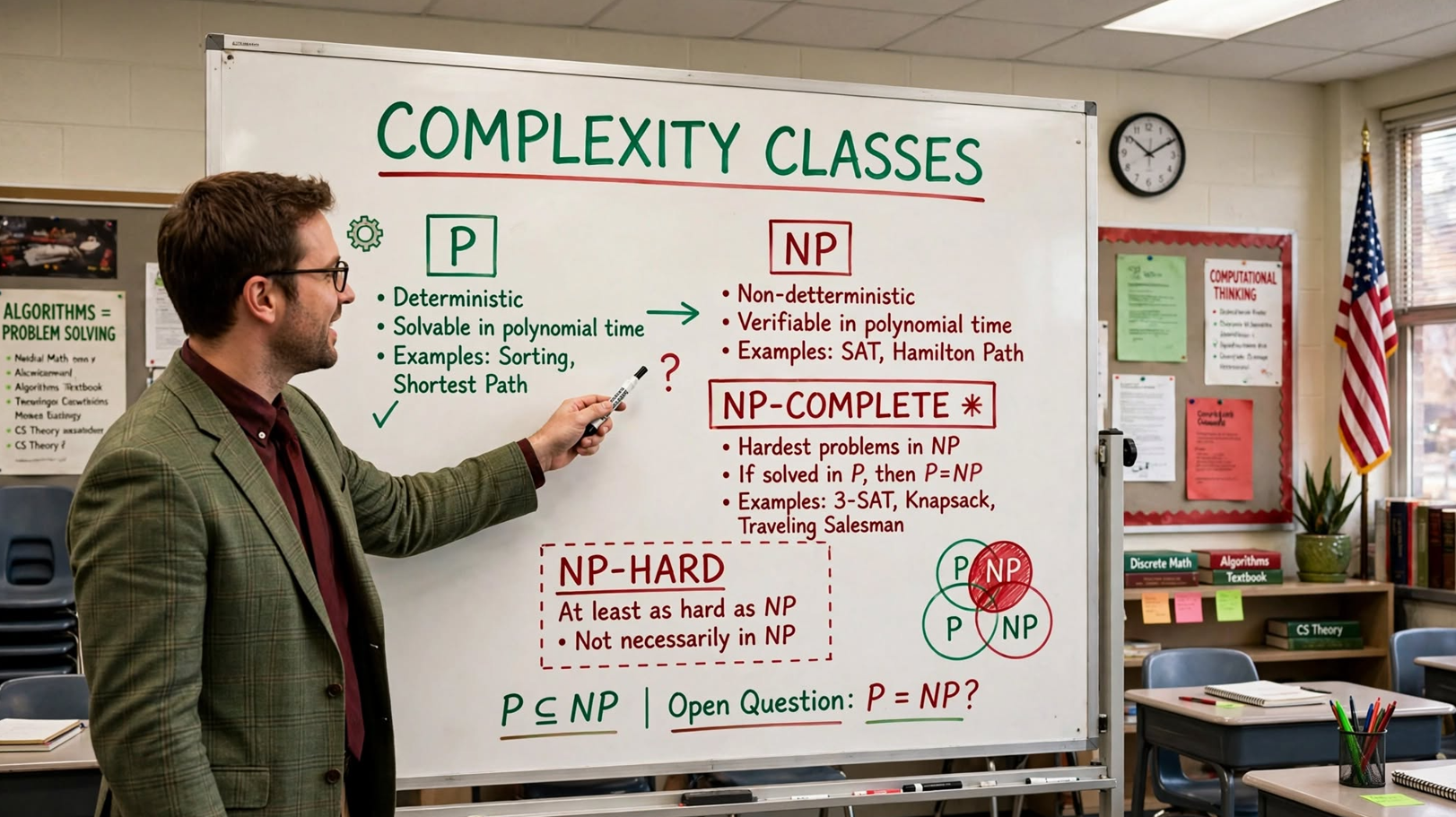
P, NP, CoNP, NP-hard and NP-complete: Complete Guide
P, NP, CoNP, NP-hard and NP-complete | Complexity Classes: A Comprehensive Tutorial
In computer science, problems are divided into classes known as Complexity Classes. A complexity class is a set of problems with related complexity. Complexity theory helps categorize problems based on their solvability and efficiency.
This tutorial provides an in-depth exploration of complexity classes: P, NP, Co-NP, NP-hard, and NP-complete. It covers their definitions, characteristics, examples, relationships, practical implications, and common pitfalls.
Conceptual Introduction & Fundamentals
What are Complexity Classes?
Complexity classes organize problems based on the resources (time and space) needed to solve them. They help answer:
- Which problems can be solved efficiently?
- Which problems have solutions that are easy to verify but hard to find?
- Which problems are intractable?
Polynomial vs. Exponential Time
| Type | Form | Scalability |
|---|---|---|
| Polynomial | O(nᵏ) | Scales well |
| Exponential | O(kⁿ) | Scales poorly |
Overview of Complexity Classes
| Class | Description |
|---|---|
| P | Solvable in polynomial time |
| NP | Verifiable in polynomial time |
| Co-NP | Complements of NP problems |
| NP-hard | At least as hard as hardest NP problems |
| NP-complete | Both NP and NP-hard |
Core Complexity Classes
P Class (Polynomial Time)
Definition: Decision problems solvable by a deterministic machine in polynomial time.
Characteristics:
- Solutions are easy to find.
- Problems are tractable (solvable in theory and practice).
- Most coding problems fall here.
Examples:
- Greatest Common Divisor
- Merge Sort
- Maximum matching
- Linear Search
c
#include <stdio.h> /* P Class Example: GCD using Euclidean algorithm O(log n) */ int gcd(int a, int b) { while (b != 0) { int temp = b; b = a % b; a = temp; } return a; } int main(void) { int a = 48, b = 36; printf("GCD of %d and %d: %d\n", a, b, gcd(a, b)); printf("This is a P-class problem (polynomial time).\n"); return 0; } Expected output:
text
GCD of 48 and 36: 12 This is a P-class problem (polynomial time).
NP Class (Non-deterministic Polynomial Time)
Definition: Decision problems solvable by a non-deterministic machine in polynomial time; solutions verifiable by a deterministic machine in polynomial time.
Characteristics:
- Solutions are easy to verify but may be hard to find.
- Answer can be checked in polynomial time.
Examples:
- Boolean Satisfiability (SAT)
- Hamiltonian Path
- Graph Coloring
- Employee pairing problem
c
#include <stdio.h> #include <stdbool.h> /* NP Class Example: Verify subset sum solution */ bool verifySubsetSum(int arr[], int n, int subset[], int subsetSize, int target) { int sum = 0; for (int i = 0; i < subsetSize; i++) { sum += subset[i]; } return sum == target; } int main(void) { int arr[] = {3, 34, 4, 12, 5, 2}; int n = sizeof(arr) / sizeof(arr[0]); /* Given solution: {4, 5} sums to 9 */ int subset[] = {4, 5}; int subsetSize = 2; int target = 9; if (verifySubsetSum(arr, n, subset, subsetSize, target)) { printf("Solution verified: subset sums to %d\n", target); } printf("Subset Sum is an NP-class problem (easy to verify).\n"); return 0; } Expected output:
text
Solution verified: subset sums to 9 Subset Sum is an NP-class problem (easy to verify).
Co-NP Class
Definition: The complement of NP. If the answer is “No,” there’s a proof verifiable in polynomial time.
Characteristics:
- Complement of NP problems.
- “No” answers can be verified quickly.
Examples:
- Prime checking
- Integer factorization verification
c
#include <stdio.h> #include <stdbool.h> /* Co-NP Example: Verify a number is NOT prime */ bool hasFactor(int n) { for (int i = 2; i * i <= n; i++) { if (n % i == 0) return true; // Found a factor } return false; } int main(void) { int num = 15; if (hasFactor(num)) { printf("%d is NOT prime (verified by finding factor)\n", num); } printf("Prime checking is in Co-NP (easy to verify 'No').\n"); return 0; } NP-Hard Class
Definition: Problems at least as hard as the hardest problems in NP. Every NP problem reduces to NP-hard problems.
Characteristics:
- Not all NP-hard problems are in NP.
- Solutions take long to verify.
- Polynomial-time reduction from all NP problems.
Examples:
- Halting problem
- Qualified Boolean formulas
NP-Complete Class
Definition: Problems that are both NP and NP-hard.
Characteristics:
- Hardest problems in NP.
- If one NP-complete problem is solved in polynomial time, all NP problems can be.
Examples:
- Hamiltonian Cycle
- Satisfiability
- Vertex Cover
c
#include <stdio.h> #include <stdbool.h> /* NP-Complete Example: Verify Hamiltonian Cycle solution */ bool verifyHamiltonianCycle(int graph[][5], int path[], int n) { /* Check if path forms a valid cycle */ for (int i = 0; i < n; i++) { int from = path[i]; int to = path[(i + 1) % n]; if (graph[from][to] == 0) return false; } /* Check all vertices visited exactly once */ bool visited[5] = {false}; for (int i = 0; i < n; i++) { if (visited[path[i]]) return false; visited[path[i]] = true; } return true; } int main(void) { int graph[5][5] = { {0, 1, 0, 1, 0}, {1, 0, 1, 1, 1}, {0, 1, 0, 0, 1}, {1, 1, 0, 0, 1}, {0, 1, 1, 1, 0} }; /* Given Hamiltonian Cycle: 0-1-2-4-3-0 */ int path[] = {0, 1, 2, 4, 3}; int n = 5; if (verifyHamiltonianCycle(graph, path, n)) { printf("Hamiltonian Cycle verified!\n"); } printf("Hamiltonian Cycle is NP-complete.\n"); return 0; } Full Practical Code Example with Explanation
This program demonstrates different complexity classes with practical examples.
Program: Complexity Classes Demo
c
/** * complexity_classes.c * Demonstrates P, NP, Co-NP, NP-hard, and NP-complete classes. * Shows solvable vs verifiable problems with C examples. */ #include <stdio.h> #include <stdlib.h> #include <string.h> #include <stdbool.h> #include <errno.h> #include <math.h> #define MAX_LINE_LEN 100 #define MAX_NODES 10 /* Function prototypes */ void demonstratePClass(void); void demonstrateNPClass(void); void demonstrateCoNPClass(void); void demonstrateNPCompleteClass(void); void demonstrateComplexityComparison(void); int gcd(int a, int b); bool verifySubsetSum(int subset[], int subsetSize, int target); bool isPrime(int n); bool verifyGraphColoring(int graph[][MAX_NODES], int colors[], int n); int main(void) { int choice; char buffer[MAX_LINE_LEN]; printf("=== Complexity Classes Demo ===\n"); while (1) { printf("\n--- Menu ---\n"); printf("1. P Class (GCD)\n"); printf("2. NP Class (Subset Sum Verification)\n"); printf("3. Co-NP Class (Prime Checking)\n"); printf("4. NP-Complete Class (Graph Coloring)\n"); printf("5. Complexity Comparison\n"); printf("6. Exit\n"); printf("Enter choice: "); fflush(stdout); if (fgets(buffer, sizeof(buffer), stdin) == NULL) { fprintf(stderr, "Error reading choice.\n"); return EXIT_FAILURE; } choice = atoi(buffer); switch (choice) { case 1: demonstratePClass(); break; case 2: demonstrateNPClass(); break; case 3: demonstrateCoNPClass(); break; case 4: demonstrateNPCompleteClass(); break; case 5: demonstrateComplexityComparison(); break; case 6: printf("Exiting.\n"); return EXIT_SUCCESS; default: printf("Invalid choice. Please try again.\n"); break; } } return EXIT_SUCCESS; } /* P Class: GCD */ void demonstratePClass(void) { printf("\n=== P Class (Polynomial Time) ===\n"); int a = 48, b = 36; int result = gcd(a, b); printf("GCD of %d and %d: %d\n", a, b, result); printf("Time: O(log n) — efficiently solvable.\n"); printf("GCD is in P class.\n"); } /* GCD: P class */ int gcd(int a, int b) { while (b != 0) { int temp = b; b = a % b; a = temp; } return a; } /* NP Class: Subset Sum Verification */ void demonstrateNPClass(void) { printf("\n=== NP Class (Verifiable in Polynomial Time) ===\n"); /* Given subset that sums to 9 */ int subset[] = {4, 5}; int subsetSize = 2; int target = 9; if (verifySubsetSum(subset, subsetSize, target)) { printf("Subset {4, 5} verified: sums to %d\n", target); } printf("Finding the subset is hard; verifying is easy.\n"); printf("Subset Sum is in NP class.\n"); } /* Verify subset sum: NP class */ bool verifySubsetSum(int subset[], int subsetSize, int target) { int sum = 0; for (int i = 0; i < subsetSize; i++) { sum += subset[i]; } return sum == target; } /* Co-NP Class: Prime Checking */ void demonstrateCoNPClass(void) { printf("\n=== Co-NP Class (Complement of NP) ===\n"); int num = 17; if (isPrime(num)) { printf("%d is prime (verified in polynomial time)\n", num); } printf("Checking 'No' answers is in Co-NP.\n"); } /* Prime check: Co-NP */ bool isPrime(int n) { if (n <= 1) return false; if (n <= 3) return true; for (int i = 2; i * i <= n; i++) { if (n % i == 0) return false; } return true; } /* NP-Complete: Graph Coloring Verification */ void demonstrateNPCompleteClass(void) { printf("\n=== NP-Complete Class ===\n"); int graph[MAX_NODES][MAX_NODES] = {0}; int n = 4; /* Create a simple graph */ graph[0][1] = graph[1][0] = 1; graph[0][2] = graph[2][0] = 1; graph[1][2] = graph[2][1] = 1; graph[1][3] = graph[3][1] = 1; graph[2][3] = graph[3][2] = 1; /* Given 3-coloring */ int colors[] = {0, 1, 2, 0}; if (verifyGraphColoring(graph, colors, n)) { printf("Graph coloring verified (3 colors used)\n"); } printf("Finding the coloring is hard; verifying is easy.\n"); printf("Graph coloring is NP-complete.\n"); } /* Verify graph coloring */ bool verifyGraphColoring(int graph[][MAX_NODES], int colors[], int n) { for (int i = 0; i < n; i++) { for (int j = i + 1; j < n; j++) { if (graph[i][j] && colors[i] == colors[j]) { return false; // Adjacent vertices have same color } } } return true; } /* Demonstrates complexity comparison */ void demonstrateComplexityComparison(void) { printf("\n=== Complexity Class Comparison ===\n"); printf("%-15s %-40s\n", "Class", "Characteristic"); printf("%-15s %-40s\n", "P", "Easily solvable in polynomial time"); printf("%-15s %-40s\n", "NP", "Yes answers verifiable in polynomial time"); printf("%-15s %-40s\n", "Co-NP", "No answers verifiable in polynomial time"); printf("%-15s %-40s\n", "NP-hard", "At least as hard as NP problems"); printf("%-15s %-40s\n", "NP-complete", "Both NP and NP-hard"); printf("\nPolynomial time: O(n^k) — scales well\n"); printf("Exponential time: O(k^n) — scales poorly\n"); } Explanation of Complexity Classes
- P Class: GCD — solvable in polynomial time.
- NP Class: Subset Sum verification — easy to verify.
- Co-NP Class: Prime checking — “No” answers verifiable.
- NP-Complete: Graph coloring — both NP and NP-hard.
- Comparison table: Shows distinguishing features.
Expected Output (partial)
text
=== Complexity Classes Demo === --- Menu --- 1. P Class (GCD) 2. NP Class (Subset Sum Verification) 3. Co-NP Class (Prime Checking) 4. NP-Complete Class (Graph Coloring) 5. Complexity Comparison 6. Exit Enter choice: 5 === Complexity Class Comparison === Class Characteristic P Easily solvable in polynomial time NP Yes answers verifiable in polynomial time Co-NP No answers verifiable in polynomial time NP-hard At least as hard as NP problems NP-complete Both NP and NP-hard Polynomial time: O(n^k) — scales well Exponential time: O(k^n) — scales poorly
Common Pitfalls, Edge Cases & Memory Considerations
1. Confusing NP with “Not Polynomial”
NP stands for “Non-deterministic Polynomial,” not “Not Polynomial.”
Solution: Remember NP means verifiable in polynomial time.
2. Assuming P = NP
Whether P = NP is an unsolved problem in computer science.
Solution: Understand it’s an open question.
3. Not Distinguishing NP-hard from NP-complete
NP-hard problems may not be in NP; NP-complete must be both.
Solution: NP-complete = NP ∩ NP-hard.
4. Thinking All Hard Problems are NP-complete
Some hard problems (halting problem) are NP-hard but not NP-complete.
Solution: Check if problem is in NP before claiming NP-complete.
5. Not Verifying Solutions Carefully
Verification algorithms must be correct and efficient.
Solution: Test verification with valid and invalid solutions.
6. Memory Leaks in Test Code
Forgetting to free allocated memory.
Solution: Always free allocated memory.
7. Integer Overflow
Large computations overflow.
Solution: Use appropriate data types.
8. Not Handling Edge Cases
Empty sets, single elements need special handling.
Solution: Test with boundary values.
9. Confusing Decision vs Optimization
Complexity classes typically apply to decision problems.
Solution: Frame problems as yes/no questions.
10. Memory Considerations
- Verification algorithms use O(n) or less space.
- Graph structures use O(n²) space.
- No special memory requirements for classification.
Summary & Best Practices
Complexity classes organize problems by their computational difficulty. Understanding P, NP, Co-NP, NP-hard, and NP-complete is essential for algorithm design and problem classification.
Key Takeaways
- P: Solvable in polynomial time.
- NP: Verifiable in polynomial time.
- Co-NP: Complement of NP.
- NP-hard: At least as hard as NP.
- NP-complete: Both NP and NP-hard.
- P ⊆ NP (open whether P = NP).
- NP-complete ⊆ NP-hard.
Best Practices
- Understand problem classification.
- Design polynomial-time algorithms when possible.
- Recognize NP-complete problems to avoid seeking efficient solutions.
- Use verification for NP problems.
- Document complexity class in code.
- Test verification with edge cases.
- Free allocated memory.
- Use appropriate data types.
- Understand the P vs NP question.
- Study reductions between problems.
By mastering complexity classes, you’ll understand problem difficulty and make informed decisions about algorithm design.